%20(2)-2.png?width=2551&height=852&name=innosphere-logo-reverse%20(1)%20(2)-2.png)
.png?width=50&name=image%20(34).png)

Most CEOs know who reports to whom. Far fewer know who owns which process or who is truly...
Your best people are making avoidable mistakes. Not because they're underqualified. Not because they don't care. Because your business has grown complex enough that human memory alone is no longer a reliable system.
That's the central argument of Atul Gawande's The Checklist Manifesto, and while Gawande writes primarily about surgery and aviation, the implications for business leaders are hard to overstate. This is a book about operational excellence, team coordination, and why smart organizations build process instead of relying on individual heroics.
Complexity Is the Real Threat to Your Business
Businesses don't usually fail because they hired incompetent people. They fail because they scaled beyond what informal processes can handle.
When your team is small, tribal knowledge works. Everyone knows the steps. Everyone remembers the important details. But as headcount grows, as products multiply, as customer demands diversify, the gap between "what we should do" and "what we actually do" widens. Gawande calls this the "checklist problem." Professionals at the top of their field forget critical steps not because they're careless, but because they're operating in environments too complex for memory alone.
The business equivalent is everywhere. A verbal offer goes out above the approved salary band because the hiring manager didn't check first. A company credit card stays active for weeks after termination because finance wasn't on the checklist. A departing employee keeps GitHub access for three months because IT was never notified. A new hire's laptop isn't provisioned until day three, so they spend their first week doing nothing. An employee is blindsided by critical feedback in an annual performance review because no interim conversations were ever documented. Each mistake is traceable not to negligence, but to the absence of a reliable system.
The Surgical Proof of Concept
When the World Health Organization asked Gawande to improve surgical safety outcomes, he didn't design new training programs or hire more senior staff. He created a nineteen-item checklist: a two-minute process completed before every operation.
The results were striking. Major complications dropped by 36% and deaths fell by 47%.
The checklist didn't make surgeons more skilled. It made sure they consistently applied the skill they already had.
The business translation is direct. Your onboarding process, your sales handoff, your quarterly close, your product launch. If these rely on individuals remembering the right steps at the right time, you have a checklist problem. The cost isn't always a single dramatic failure. More often it's the slow drag of inconsistency. Customers who get different experiences, projects that slip for reasons that keep repeating, quality that varies by who's on shift.
What Aviation Teaches Us About Scaling Operations
The aviation industry confronted this problem decades ago. After a 1935 crash of Boeing's prototype B-17, caused not by mechanical failure but by a pilot forgetting to release a control lock, the industry developed what would become the modern flight checklist. Today, commercial aviation operates through layered checklists covering every phase of flight, including emergency scenarios for failures that haven't happened yet.
The result is an industry that manages extraordinary complexity, thousands of interdependent variables, multiple crew members, and changing conditions, with remarkable consistency and safety.
What business can learn from aviation isn't just the tactic of checklists. It's the cultural decision behind them. Expertise is not diminished by process. The most skilled pilots in the world still run pre-flight checks. Competence and protocol aren't opposites; they're partners.
Two Checklist Models for Business Operations
Gawande distinguishes between two types of checklists, both of which have direct business applications.
DO-CONFIRM checklists let professionals work through a task using their judgment and experience, then pause to verify completion. This is the right model for creative or variable work, such as a content review process, a client proposal sign-off, a sales call debrief. The checklist doesn't script the work; it confirms the critical items weren't missed.
READ-DO checklists walk users through each step in sequence before proceeding. These suit high-stakes, repeatable procedures where order matters, such as a software deployment, a financial reconciliation, a compliance audit. Nothing moves forward until each item is verified.
The design principle matters as much as the type. Gawande is emphatic that good checklists are short. They capture only the "killer items," the steps most likely to be skipped and most costly when they are. A checklist that tries to document everything becomes a manual nobody reads. The discipline is knowing what to leave out.
The Real Cost of the Lone Genius Model
Business culture celebrates the exceptional individual. The founder who operates on instinct, the star salesperson who closes on feel, the engineer who just knows how the system works. These people are valuable. They're also a liability if your organization is built around them.
Gawande points to the 2008 financial crisis as a case study in what happens when complexity outpaces structure. Financial instruments became so layered that even their architects couldn't fully model the risk. Brilliant people, operating without adequate systems, made decisions that cascaded into global failure.
The same dynamic plays out at smaller scale in businesses every day. When your best account manager leaves, do client relationships survive intact? When your lead developer is sick on launch day, does the team know every critical step? Single points of failure built around individual expertise are operational risk masquerading as talent.
The antidote isn't replacing great people. It's building systems that capture and distribute what they know, so that expertise becomes institutional rather than personal.
Why Your Team Resists Checklists (And How to Change That)
Here's the adoption problem every leader faces. The people who most need checklists are often the most resistant to them. Senior employees, experienced managers, high performers frequently view process as bureaucracy and checklists as an insult to their competence.
Gawande felt this himself as a surgeon. The resistance is human and understandable. But he argues the reframe is straightforward. Checklists aren't for average performers. They're for experts who operate in complex environments where even excellence isn't enough to guarantee consistency.
The cultural shift required is from "trust our people" to "trust our people and our systems." These aren't in conflict. The best organizations do both. Making that case to your team, and modeling it from leadership, is often more important than the checklist design itself.
Where to Start in Your Business
The highest-value targets for business checklists are processes that are high-stakes, repeatable, and currently dependent on individual memory. Common candidates include
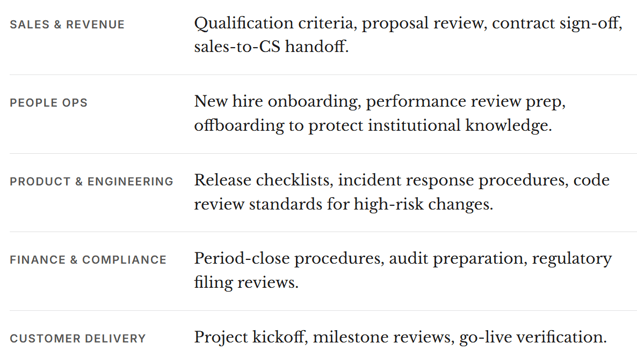
Start with the process where a mistake has cost you the most in the last year. Build a minimal checklist of no more than nine items. Test it with the team doing the work, not just the team designing the process. Refine it based on what actually gets caught.
The Competitive Case for Process Discipline
There's a business argument here beyond error reduction. Organizations that operate through reliable systems scale faster, onboard people more effectively, maintain quality across growth, and are less exposed when key people leave.
Checklists are one building block of that kind of organization. They're not the whole answer. But The Checklist Manifesto makes a compelling case that they're an underused one, and that the businesses most resistant to them are often the ones that would benefit most.
The question isn't whether your team is talented enough to succeed without them. It's whether your systems are strong enough to make success consistent.
Most aren't. A checklist is a good place to start fixing that.
.png?height=200&name=TRM%20graphic%20BLOG%20(490%20x%20316%20px).png)
Leave a Comment!