%20(2)-2.png?width=2551&height=852&name=innosphere-logo-reverse%20(1)%20(2)-2.png)
.png?width=50&name=image%20(34).png)
Most organizations know they have a retention problem. Far fewer know why. The answer lives at the...
Most CEOs know who reports to whom. Far fewer know who owns which process or who is truly accountable for each function. Verne Harnish's PACE and FACE charts fix that. Here's what they are, why they're different, and why every CEO and COO needs both.
The traditional org chart tells you one thing: who reports to whom. What it doesn't tell you is who owns the customer onboarding process when it breaks, or who is accountable for the finance function when the numbers don't add up. At ten employees, everyone just knows. At fifty, it gets murky. At two hundred, it becomes the single biggest source of dropped balls, duplicated effort, and quietly festering blame.
Harnish's answer in Scaling Up is two complementary tools PACE and FACE that make accountability explicit, visible, and impossible to dodge.
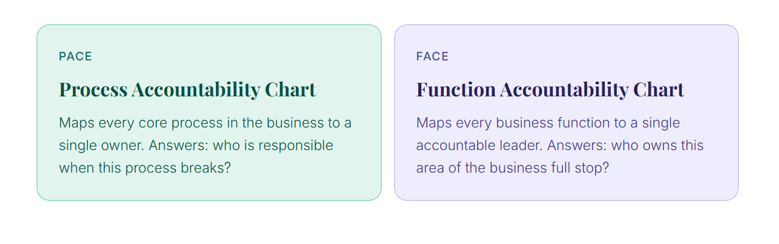
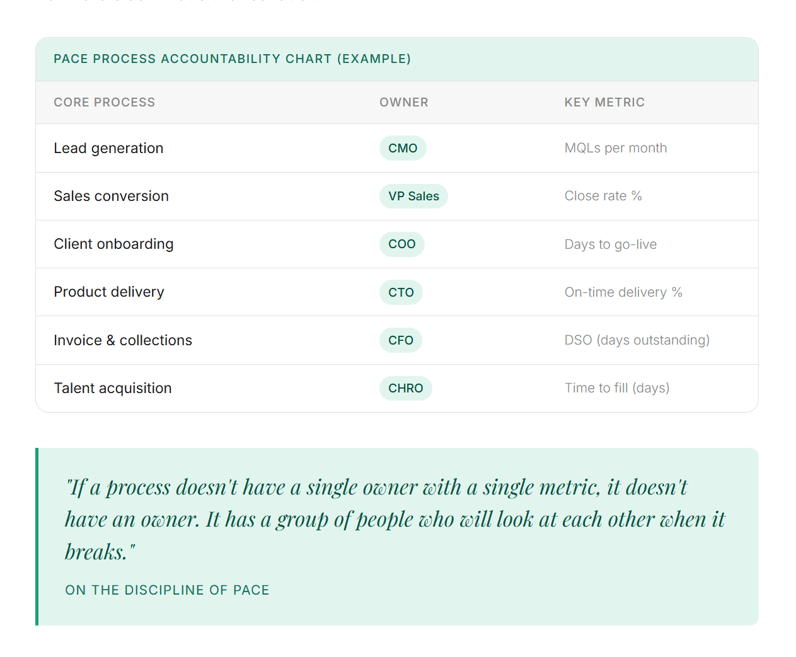
PACE: the Process Accountability Chart
Every company runs on processes whether they're documented or not. Customer acquisition, product delivery, invoicing, hiring, onboarding. The PACE chart lists every core process and assigns a single person as its owner. Not a team. Not a committee. One name.
The power of PACE is not the chart itself it's the conversation it forces. When you sit down to build one, you immediately discover processes that nobody owns, processes that two people think they own, and processes that exist in someone's head and nowhere else. That's the real audit.
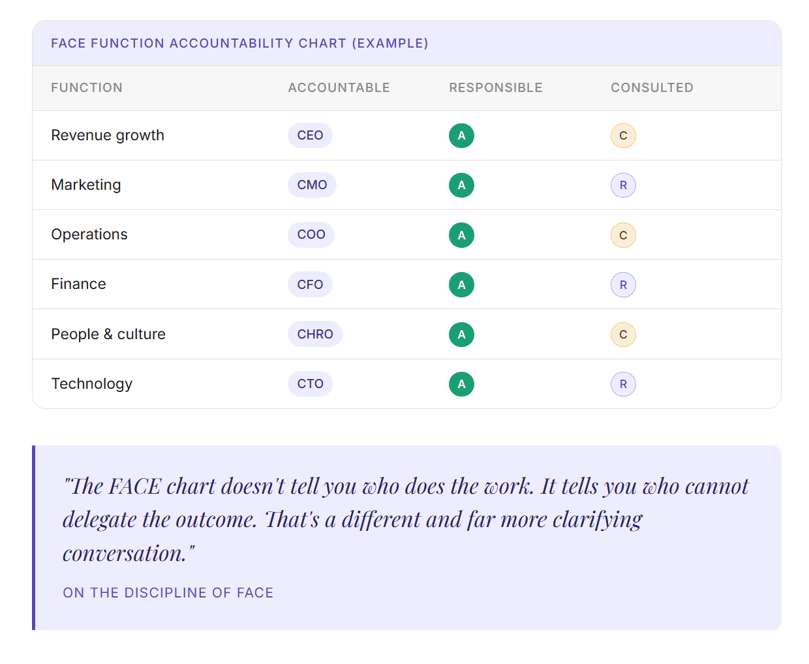
FACE: the Function Accountability Chart
Where PACE maps processes, FACE maps functions the standing disciplines of the business: sales, marketing, finance, operations, technology, people. Every function needs one accountable leader. Not the person who does the most work in it. The person whose name goes on the result.
FACE also captures the RACI layer who is Accountable, who is Responsible for execution, and who needs to be Consulted or Informed. This is where most scaling companies discover that their perceived org chart and their actual decision-making chart are two completely different documents.
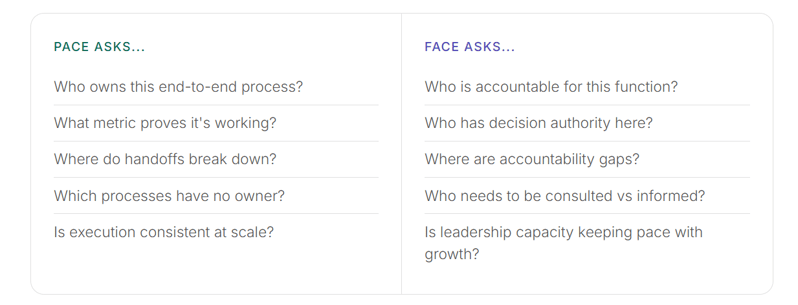
PACE vs FACE understanding the difference
CEOs and COOs often ask: do I need both? The answer is yes because they answer different questions and expose different gaps.
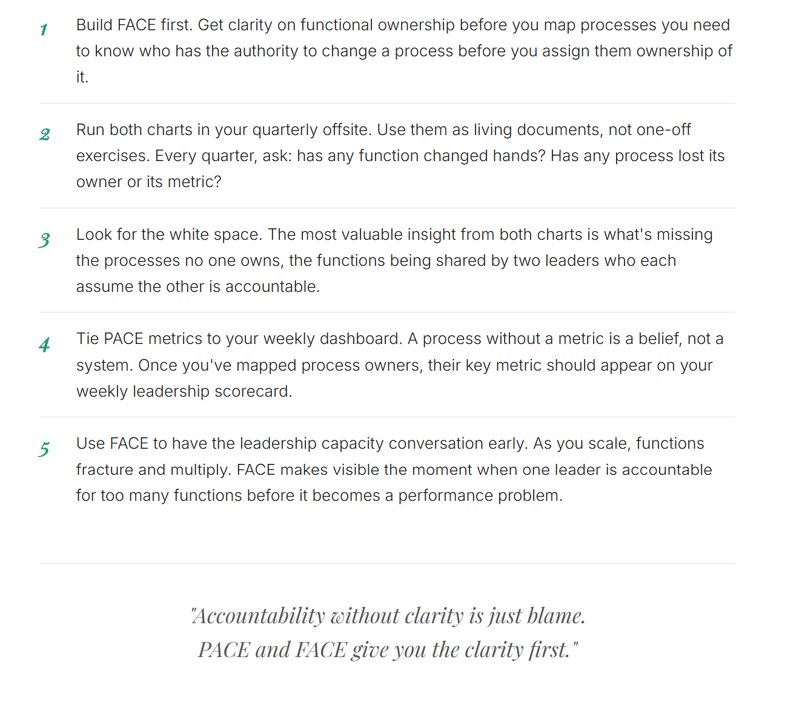
What CEOs and COOs should do with them
.png?height=200&name=TRM%20graphic%20BLOG%20(490%20x%20316%20px).png)

Leave a Comment!